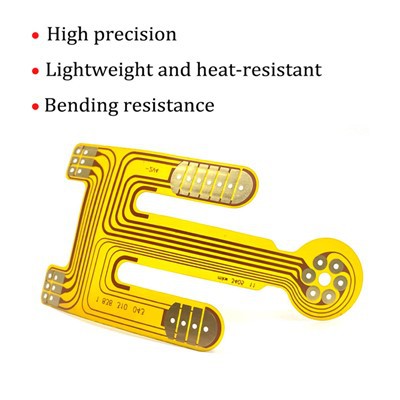
A flexible PCB substrate utilizes a dielectric base layer made of a flexible polymer material such as polyimide or polyester. Conductive copper traces are laminated onto the flexible base layer to create a thin, bendable circuit board. The absence of rigid fiberglass reinforcement allows the flex PCB to be dynamically flexed and contorted during use.
Common names used to refer to flexible PCBs: Flex circuits,Flexible circuits,Flexible printed circuits,Flex prints.
Key properties that distinguish flex PCBs include flexibility, lightweight nature, dynamic behavior, durability, integration with components, space-saving design, and customizability. These capabilities enable flexible circuits to meet the complex physical and electrical demands in compact, portable electronic devices.
Common types and applications of flexible PCBs

Flexible circuits can be utilized in various configurations for interconnect and packaging applications:
1. Flexible Interconnects – Simple conductor traces or wire patterns are used over flexible substrates to connect PCBs, displays, and other modules over dynamic movements.
2. Flexible Cables – Utilize parallel conductor traces over rolled flex substrates to create high-density ribbon cables for signal, data, and power interconnections.
3. Membrane Switches – Integrate conductor traces, spacers, and flexible overlays to produce ultra-thin touch-sensitive control switches.
4. Flex Rigid Boards – Incorporate rigid boards with flexible sections to create compactly foldable hybrid PCBs with complex rigid portions.
5. Flexible Heaters – Pattern resistive heating elements on flex substrates to create thin heating pads and blankets capable of conforming to surfaces.
Some common applications of flex PCBs include medical instruments, wearable devices, robotics and industrial machines, consumer electronics, automotive electronics, aerospace, and military systems. Flex circuits' flexibility, lightweight, and dynamic characteristics enable innovative design possibilities.
Flexible PCB manufacturing process
The manufacturing process of PCB is structured. Its three significant steps are as follows:
Step 1: Flex PCB Build Up
It is one of the very first phases of this PCB manufacturing process, where the aim is to save the base materials. Polyimide is one of the primary materials in flex circuits. This polyimide material is costlier than FR-4 and requires extra care during use. In the nesting technique, the closed circuits help properly use polyimide. The prototype flex PCB manufacturing includes:
1. Looping:
It is acceptable to add a small amount of extra material beyond the requirements of the designers. For example, service loops enable circuit assembly and servicing lengths by adding material.
2. Sizing Conductor
Dynamic applications recommend the thinnest copper, as it offers excellent flexibility.
3. Etching
During the manufacturing process, this process compensates for any isotropic losses. Because of this process, almost twice as much copper foil thickness is lost in line width. Several factors affect line widths, such as copper types, etch masks, conductors, etc.
4. Routing
The conductor's routing process is more accessible and quick. To bend and fold, get in a perpendicular position. This will then improve the bending and folding with an effective stress reduction.
5. Ground Planes
If there is adequate electrical allocation, then create the ground areas cross-hatched. Reducing the weight of the circuit board improves the flexibility of the circuit.
 Step 2: flexible circuit board Fabrication Process
It is necessary to have an electrical conductor width of 375 micrometers for polymer thin films. At the same time, both silver-based polymer films and nominal polymer thick films conduct circuit currents. In addition, different designs and applications require different hole diameters in flexible PCBs.
1. Hole Size
As well as creating tiny holes, the manufacturer creates flexible PCB layouts. As a result, the holes are as small as 25μm, and advanced technology can make it happen.
2. Filleting
In this filleting process, you can multiply the pad area and divide the stress. All of the land termination and pads in the flex PCB require filleting. For a reliable solder joint, the plated through-hole is suitable.
3. Button Plating
It requires the substitute plated through-hole. The manufacturer made the vias and through-hole using copper.
Step 3: Concentrate on Physical Constraints
This process of manufacturing deals with the cover coating problem and cover layers. Some of the few cover layers include:
1. Adhesive Backed Flims
The raw materials present in this film are suitable for dynamic flex circuit apps. In the case of overcoating custom PCBs, it uses adhesive-backed films.
2. Screen Printable Liquid Overcoats
Generally, screen-printable liquid overcoats use thick polymer films.
3. Photo-imaginable liquid and film polymers
We can consider it as one of the advanced over-coating methods with some surprising functionalities:
The solder can't connect circuit traces with this solder mask.
Both internal and external components protect the circuit.
It helps to prevent the circuit from external electrification.
group profile
Adhering to the spirit of independent innovation, we continue to deepen the ODM business, explore the new energy vehicle market, provide strong technical support for the development of the industry with strong innovation capabilities, and provide professional services and excellent products for the industry with solid patented technical strength. The group has more than 70 software and hardware development engineers, 86 patents, and has passed the certification of ISO9001, ISO14001, IATF16949, ISO13485, and intellectual property implementation system, and has won the honors of high-tech enterprise, Fujian Science and Technology Little Giant Leading Enterprise, Xiamen Specialized and Special New Enterprise, and Tax Star Enterprise.

Based on rich experience, massive data, cutting-edge algorithms, and world-leading digital capabilities, relying on flexible and advanced management models and professional and efficient talent teams, Goldwind services collaborate with the whole industry chain to provide integrated and one-stop services such as clean energy planning and design, engineering construction and intelligent operation for the whole life cycle of new energy projects, explore new models of quality and efficiency improvement in the era of smart energy, and achieve safe and stable supply of green energy and economic growth.

Our company adheres to the principle of "monograph quality, outstanding future" and has maintained a good competitive advantage in product development and manufacturing. We are in line with the concept of continuous improvement and sustainable management, and constantly improve the innovative content of products and product quality.

Q: What are the advantages of flexible circuit boards?
A: The advantages of flexible circuit boards are manifold. First of all, it has very good flexibility and bending resistance, which can adapt to a variety of complex shapes and structures, and reduce the specification constraints of electronic products. Secondly, due to the reduction of the thickness of the circuit board, the overall weight of electronic products using flexible circuit boards is also relatively light, which is conducive to the design and manufacture of products. In addition, the flexible circuit board also has higher reliability and seismic performance and can maintain the normal operation of the circuit board in complex working environments.
Q: What fields can flexible PCB substrate be used in?
A: Due to its unique features and advantages, flexible circuit boards have a wide range of applications in various fields. For example, in the medical field, flexible circuit boards can be used in medical devices such as heart rate monitors, blood pressure monitors, and artificial organ controllers. In addition, in the aerospace field, flexible circuit boards can be used in equipment such as aircraft and satellites to help them work more stably and reliably. In consumer electronics such as smartphones and tablets, flexible circuit boards are also widely used.
Q: How is a flexible circuit board different from a traditional circuit board?
A: Traditional circuit boards are made of rigid substrates, which have strong rigidity and wear resistance, but the scope and shape of use are relatively limited. Whereas, flexible circuit boards are manufactured with non-rigid substrates, which are highly flexible and bendable, and can adapt to various shapes and structures.
Hot Tags: flexible pcb substrate, China flexible pcb substrate manufacturers, suppliers, factory, Flexible Printed Circuit Board, Flexible Fpc, Comfier Eye Massager, , Flexible Printed Board