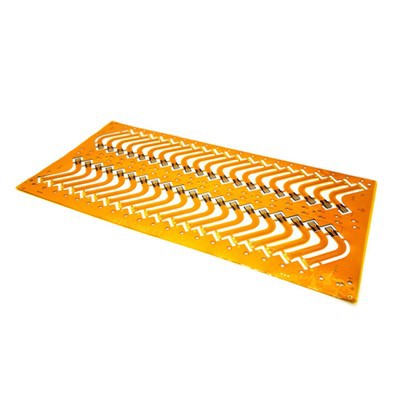
As an emerging electronic component,flex printed circuits have been widely used in various fields, including smartphones, tablets, wearable devices, medical devices, automotive electronics, etc., with a variety of superior properties such as lightweight, soft, bendable, and repeatable.
advantages of flexible circuit boards

Flexible circuit boards offer the following advantages:
(1) Light, thin and soft: Compared with the traditional hard and brittle board, the flexible circuit board is lighter and softer, which is conducive to the design of more detailed products;
(2) Bendable: It can be made according to complex shapes to meet different application needs, such as curling, twisting, folding, etc.;
(3) Repeatable bending: the flexible circuit board can return to its original state after bending, which will not affect the circuit performance, and is suitable for application scenarios that require frequent deformation;
(4) High-density wiring: The flexible circuit PCB uses flexible materials as the substrate, so it can control the size of the circuit board while improving the installation density of the components on the board, so as to achieve more refined circuit design and wiring.
The range of applications for flexible circuit boards
Flexible circuit boards have been widely used in many fields, including:
(1) Consumer electronics: smart phones, tablets, wearable devices, etc.;
(2) Household appliances: smart home systems, home appliance controllers, etc.;
(3) Medical equipment: medical testing instruments, implantable medical equipment, etc.;
(4) Automotive electronics: car navigation system, car audio, etc.;
(5) Aerospace: avionics instruments, satellite communications, etc.
the manufacturing process of flexible circuit boards
The fabrication process of flexible printed circuit assembly is more complex than that of traditional rigid boards, and usually includes the following steps:
(1) Substrate preparation: select flexible substrates containing insulating materials, such as polynitrile film (Kapton), polyimide film (PI), etc.;
(2) Circuit diagram design: design the circuit diagram according to the requirements, including the installation position and channel design of the components;
(3) Circuit board production: through photolithography process, chemical corrosion process or machining process, the circuit diagram is transformed into the actual circuit board;
(4) Component installation: install the components in the circuit diagram on the circuit board, and make it firmly connected with the circuit board through brazing technology;
(5) Final test: test the stability and reliability of the signals of each circuit of the flexible circuit board to ensure that it meets the quality requirements.
the future of flexible boards
With the rapid development of science and technology, flex printed circuits will have a broader market and application space in the future. With the growing demand for portable, intelligent and functional diversification, flexible circuit boards will become an important part of many fields, and their manufacturing technology and application fields will continue to expand. With the continuous  improvement of flexible circuit boards in terms of production cost, flexibility, durability, etc., their application fields will become more and more extensive, and it is expected to become a major trend in the electronic product manufacturing industry in the future.
1. the application field is expanded
At present, flexible circuit boards are mainly used in the field of mobile devices, and in the future, it will be used in more fields. For example, in the medical and health field, flexible circuit boards can be made into wearable devices that can be close to the skin, and have a wide range of application prospects in medical monitoring, health management and other fields. In the field of smart home, flexible circuit boards can be made into intelligent curtains, as well as lighting devices that can adapt to the home environment. In the automotive field, flexible circuit boards can be used to make car bodies of various shapes, making the car shape more beautiful. In short, the application field of flexible circuit boards will be more and more extensive in the future.
2. Technological innovation
With the continuous development of technology, the production technology of flexible circuit boards is also constantly innovating. For example, the currently commonly used FPC (Flexible Printed Circuit) technology will change, and new flexible circuit board manufacturing technologies such as thin films will be applied to flexible circuit boards, which will make it easier for people to formulate the shape and size of flexible circuit boards according to different needs. At the same time, R&D personnel are also exploring new electronic materials, such as stretchable electronic fibers, carbon nanotubes, silver nanowires, etc., which can be applied to the manufacturing of flexible circuit boards, which can improve the bending and durability of flexible circuit boards.
3.the growth of market demand
At present, the market demand for wearable technology, smart Internet of Things technology, smartphones, tablets and other mobile devices is growing rapidly, which makes flexible circuit boards have a wide range of application prospects in the market.
Group Profile

The company is positioned as a full-service provider of EMS (Electronic Manufacturing Services), and the company is positioned as a mid-to-high-end FPC &FPCA production and service, which can provide high-quality services such as FPC & FPCA processing and production, layout design, component procurement, processing and manufacturing, and complex packaging devices such as BGA, CSP, POP, etc.

We can provide customers with single and double-sided boards, high multi-layer panels, rigid-flex composite boards, special process soft boards, etc.; We can also customize the products required by customers according to the drawings or samples provided by customers. We strictly control the quality of products at every step in the manufacturing process and provide leading technical support. Before cooperating, we will have a professional technical team to answer for you. In the process of cooperation, we have a professional technical team to serve you. After cooperation, we have dedicated technicians to serve you one-on-one.

Q: What are the applications of flexible circuit boards?
A: Flexible circuit boards have many applications, including portable electronic devices, smart watches, flat panel TVs, automotive electronics, medical devices, etc. The advantage of flexible circuit boards is that electronic components can be integrated into flexible materials to better adapt to the needs of product design. Flexible circuit boards can be designed to be lightweight, small, and durable, which improves the performance of the product.
Q: Why choose a flexible circuit board?
A: When it comes to choosing electronic components, flex printed circuits have many advantages. First, they can achieve design shapes and sizes that are not possible with traditional rigid circuit boards. Secondly, flexible circuit boards can reduce the overall weight and volume of the product, making it more portable and easy to use. Finally, flexible circuit boards can reduce the failure rate and failure rate of the circuit, thereby improving the reliability and performance of the product.
Q: How to manufacture flexible circuit boards?
A: The manufacturing process of flexible pcb assembly is slightly different from traditional rigid circuit boards. Typically, fabric or transparent plastic is used as a substrate, layers of conductive material are coated, and then circuits are made through processes such as etching or camera irradiation, and finally nodes and connectors are added. The delicate manufacturing of flexible circuit boards requires a high level of skill and equipment, so it is important to choose a specialized manufacturer to manufacture them.
Hot Tags: flex printed circuit, China flex printed circuit manufacturers, suppliers, factory, Flexible Printed Circuit Board, , Flexible Fpc, , , Flexible Printed Board