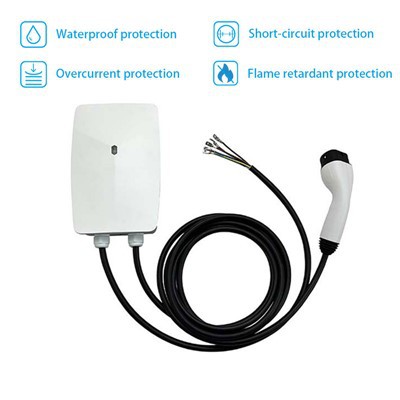
An Outdoor Home Charging Station, also commonly referred to as a charging point or EV power supply, is a piece of equipment specifically designed to charge and power plug-in electric vehicles. There are two main types of these charging stations: AC charging stations and DC charging stations. Their purpose is to provide electric vehicle owners with a convenient and efficient way to charge their vehicles, ensuring they have enough power for daily or long-distance travel.
How long does it take to charge an electric car?
Charging stations are suitable for a variety of environments, from residential areas to public spaces such as car parks and motorways. These different settings require different charging speeds and power outputs to meet the unique requirements of EV owners.
1. Level 1 Charging: Also known as trickle charging, Level 1 charging is the slowest method, providing a charging rate of 2–5 miles per hour. Level 1 EV chargers typically use a standard 120-volt household outlet. While it is best suited for overnight or extended charging at home, it may not be suitable for long journeys due to its slow speed. 1-stage charging is best suited for smaller or low-capacity batteries or plug-in hybrid electric vehicles.
2. Level 2 Charging: A Level 2 charger is a speed upgrade that provides a charging rate of approximately 40–240 miles per hour using a 10-volt electrical service. It can be used in residential, public, and workplace charging locations. level 2 EV chargers are ideal for those who need a faster charge and can often be used in public areas such as hotels, shopping centers, and car parks. For Level 2 charging at home, a charging station may need to be installed, a service usually provided by a licensed electrician or an EV charging company such as WattLogic.
3. DC Fast Charging: DC Fast Charging is the fastest method of charging, with a typical power output of 50–350 kW. These public charging stations are designed to charge an EV's battery in as little as 20–30 minutes. DC fast charging stations are usually located along travel corridors and are ideal for quick charging on long journeys. Although the most expensive option, some entities may offer DC fast chargers for free to promote EV adoption.
Benefits of installing an electric car charger at home
As more and more people turn to electric vehicles, the importance of installing an electric car charger at home becomes apparent. This article explores the compelling advantages of installing an EV charger at home, from convenience and cost savings to contribution to the environment.
1. Convenience and accessibility
The convenience of installing an EV charger at home cannot be overstated. Consider a scenario where a busy professional relies on their electric vehicle for their daily commute. Without a home charger, they would need to consider the time it takes to find a charging station, wait their turn, and alter their schedule to accommodate the charging process. However, with a home EV charger, they simply plug in their vehicle when they get home and it's ready to go the next day. This seamless integration into their daily lives eliminates unnecessary stress and time spent searching for a charging station.
2. Save on energy and fuel costs
Over time, the financial advantages of charging an electric vehicle at home become apparent. Let's compare the cost of electricity and gasoline. On average, electric cars are more energy efficient than conventional internal combustion engine vehicles. The cost of electricity per mile can be significantly lower than the equivalent distance for gasoline. This difference is even more pronounced when electricity is cheaper during off-peak hours.
3. Contributing to a greener environment
The environmental impact of electric cars becomes apparent when we analyse the reduction in greenhouse gas emissions. Let's take a real-world example: the average gasoline-powered car in the US emits about 4.6 metric tonnes of carbon dioxide (CO2) per year. In contrast, pure electric vehicles have zero tailpipe emissions, thus significantly reducing CO2 emissions.
In addition, the source of electricity used for charging plays a critical role in determining the overall environmental impact of electric vehicles. In areas where the grid is heavily dependent on fossil fuels, emission reductions may be less pronounced. However, areas with a high percentage of renewable energy sources in the grid, such as solar or wind, offer greater environmental benefits.
Why DC fast charging is usually not suitable for home use
1. Technical barriers and limitations
The appeal of fast charging at home is undeniable, but there are practical technical barriers. Firstly, most residential neighborhoods are connected to power grids that may not be able to support the high power demands of DC charging. DC fast charging stations typically require a power output of 50 kW to 350 kW. To put this in perspective, this is the standard household outlet in North America. It provides approximately 1.8 kW of power. Essentially, installing a DC fast charger in your home is similar to expecting a household outlet to power an entire street of Christmas lights-the existing infrastructure simply cannot handle such a load.
 The problem is not just limited to the capacity of domestic wiring. Local grids that power residential neighborhoods may not be able to cope with the high power demand required for DC fast charging. Retrofitting a home to accommodate this technology will not only require significant changes to the home's electrical system, including heavy wiring and possibly new transformers but may also require upgrades to the local grid infrastructure.
2. Security and Infrastructure Challenges
These chargers are not just plug-and-play devices. Standard household electrical systems are designed to handle peak loads of about 10 kW to 20 kW. DC power travels through the veins of our homes at such high rates, accompanied by whispers of safety concerns such as overheating or fire hazards. The infrastructure, not only within our walls but extending to the grid that supports our community's energy, must be robust enough to handle such high amperage without faltering.
Additionally, the extensive safety protocols and regular maintenance schedules that public charging stations adhere to are difficult to replicate in a home environment. For example, public DC fast charging stations are equipped with advanced cooling systems to manage the heat generated during the charging process and prevent overheating. Modifying a home to include similar safety measures, as well as necessary infrastructure upgrades, can be very expensive.
3. High installation costs
One of the biggest obstacles to installing DC fast charging in your home is the high cost involved, which goes far beyond simply buying a charger. Let's break down the costs: installing a 50 kW DC fast charger can easily exceed $20,000 when considering the necessary electrical upgrades. These upgrades may include the installation of new heavy-duty circuit breakers, sturdy wiring capable of handling the increased electrical load, and possibly a new transformer to ensure that your home can receive and manage this level of power in kilowatts from the grid.
Additionally, due to the complexity and safety standards required, professional installations are non-negotiable, which adds to the overall cost. Compared to the average cost of installing a Level 2 charger (approximately $2,000 to $5,000, including minor electrical upgrades), the financial investment for DC fast charging seems disproportionately high because of the additional convenience it provides. Taking these factors into account, the high installation cost makes DC fast charging an impractical option for most EV owners to use at home.
The Importance of Multiple Payment Options for Electric Vehicle Charging Stations
With the growing popularity of electric vehicles, consumers have higher expectations for the convenience and accessibility of charging facilities. At the same time, as technology advances, payment methods have become more diverse. Therefore, supporting multiple payment methods has become one of the key factors in improving the experience of Outdoor Home Charging Stations.
1. Enhance user experience
Multiple payment methods can significantly enhance the user experience. Consumers want a seamless and convenient payment experience from any location, using any device or payment method. By accepting multiple payment methods, including credit cards, debit cards, mobile payments (e.g., Apple Pay, Google Wallet), and EV brands' proprietary payment systems, charging stations can cater to a wide range of users, thereby increasing overall customer satisfaction.
2. Improve operational efficiency
Introducing multiple payment methods not only helps to enhance the user experience but also improves the operational efficiency of charging stations. Digital payment solutions can reduce the need for cash handling and lower administrative costs and error rates. In addition, by integrating advanced payment systems, charging station operators can monitor the status of transactions in real time, manage financial processes more efficiently, and speed up cash flow.
3. Enhance market competitiveness
In a competitive market, offering multiple payment options can be a key differentiator between charging stations and their competitors. It demonstrates not only a charging station's commitment to innovation but also a focus on consumer needs. By meeting consumer expectations for payment convenience, charging stations can attract more customers and increase their competitiveness in the market.
Group Profile
ZHUHE Group has 10 subsidiaries, is a comprehensive service provider of electronic technology and electronic products, and can provide customers with professional OEM and ODM services, The company's products and technologies show a diversity of products, covering semiconductor devices, pulse motors, high-frequency transformers, inductors, and a variety of electronic products, the core components PCBA (Printed Circuit Board Assembly) & FPCA (Flexible Printed Circuit Assembly) and other products, focusing on aerospace, military, industrial control, data communications, automotive electronics, medical electronics, new energy technology, and AI smart technology. Assembly) & FPCA (Flexible Printed Circuit Assembly) and other products, focusing on aerospace, military, industrial control, data communications, automotive electronics, medical electronics, new energy technology, and AI intelligent technology, the main markets at home and abroad, the core customers throughout the United States, Japan, Germany, and other domestic and foreign customers.

In recent years, ZHUHE, adhering to the spirit of independent innovation, has continued to deepen the ODM business and develop the new energy automobile market, with a strong innovative ability to provide strong technical support for the development of the industry and a solid strength of patented technology for the industry to provide professional services and excellent products. The group has more than 70 hardware and software development engineers, 86 patents, has passed ISO9001, ISO14001, IATF16949, ISO13485, intellectual property rights through the standard system certification, access to high-tech enterprises, science and technology giants in Fujian Province, Xiamen City, specialty and specialty new enterprises, taxpaying star enterprises, and other honours.

Our company adheres to the principle of "special quality, outstanding future" and has been maintaining a good competitive advantage in product development and manufacturing. There is no peak in technology, and there is no end to research and development, we will continue to improve the innovative content of products and product quality based on the concepts of continuous improvement and sustainable management.

Q: Why do I need an Outdoor Home Charging Station?
A: With the continuous development of science and technology, people are more and more aware of the seriousness of environmental pollution, so they have embarked on the road of "green travel..". As important supporting equipment for electric vehicles, the charging pile can charge the vehicle on the spot, avoiding the trouble of long-distance charging, and it meets the new needs of users through zero-emission and resource-saving, to be widely used.
Q: How many types of charging piles are there?
A: According to the different charging methods, charging piles can be divided into AC charging piles and DC charging piles. AC charging piles are generally the more popular charging equipment, which can be used to charge ordinary household electric vehicles, while DC charging piles are a new generation of charging equipment, suitable for high-power charging occasions, such as highways, etc.
Q: How do you ensure the safety of AC charging piles?
A: To ensure the safety of AC charging piles, we must first ensure the quality and performance of the charging piles themselves, and continuously strengthen the safety management of charging piles. In addition, the safety of the charging process can also be effectively improved by taking photos to record and monitor the charging process.
Hot Tags: outdoor home charging station, China outdoor home charging station manufacturers, suppliers, factory, Flexible Fpc,